

Wave/particle duality observed in Young's double slit experiment with camera sensitive to individual photons.
What it shows:
In this demonstration we perform the double-slit interference
experiment with extremely dim light. Rather than the usual screen,
the arrival of individual photons is registered and stored
electronically. This alone is evidence for the graininess or
particle nature of light. However, we take the experiment one step
further and show that even when the light intensity is reduced down
to several photons/sec, the audience can see the familiar Young's
double-slit interference pattern build up over a period of time as
the arrival and position of each photon is stored on an electronic
screen. This addresses the question (and dilemma) of how can single
photons interfere with photons that have already gone through the
apparatus in the past, or with those that will go through in the
future, or with themselves. Finally, the slit arrangement is such
that it is possible to know which of the two slits the photons are
passing through. In that case the Young's double-slit interference
pattern does not manifest itself.
How it works:
The geometry of the experiment is simple. The ubiquitous HeNe
laser serves as the coherent light source which illuminates a
double-slit slide. The resulting interference pattern is projected
directly into a video camera sans lens. What is unusual about the
apparatus is of course the extreme light sensitivity of the video
camera and a homemade electronic interface that turns the analog
storage oscilloscope into a "storage TV monitor." The general
layout is illustrated below.

The polarized light from the laser is attenuated by two rotatable
Polaroid filters which allow one to adjust the intensity down to
barely visible. The beam is further attenuated by a 26 µ pinhole
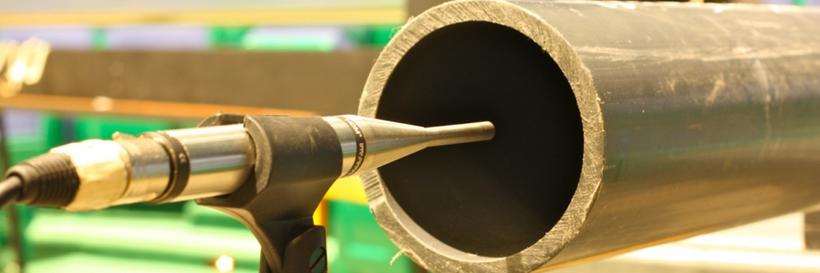
(fitted into the endcap of a 4" O.D. PVC pipe) which also serves as
a spatial filter. A disk inside the pipe holds the double-slit
slide 1 - an O-ring prevents any stray light from
getting around the disk into the camera. A light-tight seal between
the PVC pipe and video camera is provided by simply stuffing black
cloth between the extension tube (on the end of the camera) and the
pipe. The entire apparatus is light-tight enough to be used with
lecture hall lights on.
The low light level camera is a COHU 4400 series camera. 2
It's vidicon has two stages of highly sensitive optical
image intensifiers so that (according to the manufacturer) a
"usable picture is produced with only
2×10⁻⁶ lumens/ft2 " (or fc).
3 It is sensitive enough to respond to
single photons of light with a quantum efficiency of about 0.1%.
4 The distance between the source and
detector is 1.25 meters so, from a particle point of view, a photon
exists for about 4 hsec in the apparatus. Since a typical
accumulation rate of 5 photons/sec translates to an actual rate of
5000 per second, the average number of photons present at any
instant is ≈ 2×10⁻⁵; thus there is less than one photon
present at any time, even at accumulation rates several tens of
thousands times higher than what is observed in the
demonstration experiment.
The composite video output signal is processed by an
"Oscilloscope-TV Converter" 5 which generates linear
sawtooth waveforms (ramps) locked to the horizontal and vertical
video sync pulses. The ramps are fed to an oscilloscope 6
in the X-Y mode and generate a TV raster on the screen. The
composite video signal is amplified and inverted (by one of the
scope's vertical amps) and sent to the "ext Z-axis in." This
modulates the beam and produces the image. Some video signal
processing is necessary to remove internal "ion events" in the
camera that produce very bright flashes on the image. 7
A single channel analyzer (SCA) 8 is
invoked to remove these events and generates a clean TTL logic
signal to modulate the beam. Details and circuit diagrams are
presented after the Comments section. Another video camera
aimed at the oscilloscope screen allows the audience to view the
interference pattern.
The experiment is performed by turning on the laser and adjusting
the polarizer (closest to the pinhole) so that the familiar
double-slit interference pattern is seen on the oscilloscope
screen. Even at this relatively high intensity, the intensity is
low enough so that it is evident that one is seeing the
simultaneous sum of individual events -- the evidence being a very
grainy shimmering image. One can then slowly decrease the light
intensity by rotating the polarizer until the interference pattern
is no longer recognizable -- only single flashes of light appear on
the screen at a rate one can almost count. At this point the scope
is switched to the storage mode 9 and the single flashes
of light are stored "live." By integrating the events in this
manner for approximately a minute, the image of the double-slit
interference pattern is built up in real time. If desired, the
total photon count can be monitored on a scaler.
It is also possible to repeat the experiment by "forcing" the
photons to go through a particular slit. This is accomplished with
a movable razor-blade mask which can be positioned during the
course of the experiment so as to allow the light to pass through
either slit and not the other, or both slits simultaneously. The
slide holder and mask arrangement is shown below. Not shown is a
plastic cover that fits over the slide and keeps the razor blade
from falling off. A magnet (outside the PVC tube) is used to pull
the razor blade back and forth.

For example, by pulling the mask to the right, one can block the
light from passing through the left slit, integrate the photon
events for 60 seconds, "instantaneously" switch to the other slit
(without stopping the experiment) and continue integrating for
another 60 seconds. In so doing, one has allowed photons to pass
(one-at-a-time) through each of the slits for 60 seconds. From a
classical point of view, this is equivalent to the previous
experiment (assuming each photon goes through only one slit or the
other) except we now know which slit each photon is passing
through. Contrary to the classical view, no double-slit
interference pattern develops.
Setting it up:
Set up the 7313 oscilloscope as follows:
• vertical mode - left trigger source - left
• The scope does not have an X-Y mode in its time-base module.
Replace the time-base plug-in module on the scope with the 7A18
vertical amp module (it must be in the right-most slot). The
horizontal ramp is fed to ch 1 of this module, which becomes the
horizontal, or X, amp.
• The vertical ramp is fed to ch 1 of the left 7A18 vertical amp,
which becomes the vertical, or Y, amp. The composite video signal
is amplified by ch 2 of the left amp module, which becomes the Z
amp. The trigger should be ch 2 and display ch
1.
• The amp out signal (of ch 2) is fed to the ext Z-axis
in (both on the rear of the scope). Invert ch 2 (for a
positive image) and adjust the picture brightness with the ch 2
gain.
• Turn the scope's Intensity control all the way down as
this improves the contrast greatly.
• If an SCA is interposed, the lower and upper-level
discriminators (LLD & ULD) should be set to about 0.2 volt and
1.0 volt, respectively. Since the SCA output is a TTL pulse, the ch
2 gain should be reduced appropriately.
The Oscilloscope-TV Converter needs to be adjusted prior to each
use. Do so by feeding it a video signal from one of the regular
cameras aimed at an evenly illuminated test pattern. 10 Tweak the "vert adj" and "horiz adj"
pots on the Converter to yield a stable, single image on the
oscilloscope. The X and Y amplifier gains on the scope can now be
set so that the image fills the screen and is geometrically
undistorted. 11 The SCA has two outputs and, if
desired, the second output can be sent to a scaler to totalize the
photon count.
Comments:
Single photon interference experiments are not new. 12 Strictly speaking, we are not
detecting single photons of light but rather single photoelectrons,
liberated by the light impinging on the detector screen.
Nevertheless, the quantum nature of light is evident. The positions
of arrival (of the photons) are random but the probabilities of
arriving at certain positions are not. This is beautifully born out
in the demonstration.
Oscilloscope-TV Converter:
A video picture is displayed at a rate of 30 Hz. Each picture is
composed of two interlaced frames, drawn sequentially, so that
interlacing gives an effective rate of 60 frames/sec. The picture
consists of 525 horizontal lines with 262½ lines/frame. Thus
the picture is produced at the rate of 15,750 lines/sec -- the
inverse of this is 63.5 µsec/line. This establishes the required
periods for the horizontal and vertical ramps: 63.5 µsec and 16.67
msec (1/60 sec), respectively. These two ramps, when synchronized
and fed to the scope in the X-Y mode, produce a rectangular raster
display.
The composite monochrome video signal consists of horizontal and
vertical blanking and sync pulses as well as the picture
information. The oscilloscope-TV converter must strip the
sync pulses from the picture information and separate the
horizontal and vertical sync pulses to trigger the ramps. The
oscilloscope itself provides for blanking the electron beam by an
inversion of the picture signal and uses that signal for the Z-axis
(modulation) input.
The following circuit diagram illustrates the oscilloscope-TV
converter. The scheme of the circuit is to (1) amplify and
separate the synchronizing pulses from the video signal and cancel
noise, (2) sort the horizontal and vertical pulses by high and
low-pass filters, respectively, and (3) use these pulses to trigger
the sawtooth ramp generators.
Times three amplification of the composite video signal is
accomplished by the sync amp transistor which also inverts
the signal so that the sync pulses become positive. Passage through
the coupling capacitor and diode drops the video signal below
ground while leaving the sync pulses stick about one volt above
ground. This signal is applied to the base of the sync
separator transistor. It's base is biased so that it only
conducts on the positive sync pulses which are amplified and
inverted once again. The sync out signal is fed to the low
and high-pass filters.
To minimize the effect of noise in the synchronizing pulses (which
can cause momentary loss of vertical and/or horizontal
synchronization), the input composite video signal is also fed to
the emitter of the noise clipper transistor which is
base-biased to 0.24 volts. The transistor cannot conduct except on
negative noise peaks that exceed the amplitude of the negative sync
pulses (the emitter of the noise clipper is at the same
voltage as the base of the sync amp) so that the only
signals appearing at the collector of the noise clipper are
negative noise peaks exceeding the amplitude of the sync pulses.
Note that there is no phase inversion. The negative noise peaks are
capacitively coupled to the base of the noise gate
transistor whose base is biased so that it is normally conducting.
Since the sync separator and noise gate are connected
in series, both transistors must conduct for either of them
to. Thus noise pulses exceeding the synchronizing pulse amplitude
will turn off the noise gate as well as the sync
separator, thereby blocking any sync out. The vertical
and horizontal ramps will not be triggered for the duration of the
noise. 13
The separation of the vertical and horizontal sync pulses is based
on frequency -- the vertical sync pulses last 27.3 µsec while the
horizontal pulses are only 5 µsec long. The time constants of the
low-pass and high-pass filters are chosen to take advantage of this
difference. The voltages developed at the outputs of the respective
filters are converted to TTL pulses by the op-amp
comparators to provide for clean triggering of the 555
oscillators. Each of the oscillators is configured
with a transistor constant current source to linearly charge
a capacitor. The voltage on the capacitor assumes a sawtooth
waveform whose period is determined by its capacitance and the
charging current. The vertical and horizontal charging currents are
separately adjusted by the potentiometers providing the transistor
biases. The vertical ramp is further buffered, inverted and
+DC offset by the op-amps so that the raster starts in the upper
left-hand corner of the oscilloscope display.

1 Pasco Electroformed double-slit slide OS-9165B; the
slit widths are 0.04 mm and are spaced either 0.250 or 0.500 mm
apart
2 COHU
model 4410/ISIT/IT3498 (ISIT = Intensified Silicon Intensified
Target)
3 This is
equivalent to 1.9×10⁻⁷ lux (lux (lx) =
lumen/m2, thus 1 fc = 10.76 lx). Note that this is a
factor of 10 million times more sensitive than a Camcorder.
4 We are
not interested in a "usable picture" in this experiment but rather
the overall efficiency -- what percentage of the photons entering
the vidicon are actually detected. The efficiency was determined by
measuring the photon rate while a known flux (ranging from
2×10⁵ to
2×10⁸ photons/sec/cm2) of 600 nm light
was incident on the video camera. An Optronic Laboratory model 310
Low Light Level Calibration Standard was used as the light
source.
5
designed and built by Paul Titcomb (1986)
6
Tektronix model 7313 analog storage scope with two 7A18 dual
channel plug-ins.
7 These
flashes are much brighter than legitimate photon events -- indeed
they appear as 1.8 volt pulses and are much greater compared to the
1 volt p-p nominal video signal.
8 Ortec
model 551 Timing SCA
9
Persistent phosphor screen
10
Porta-Pattern™ is convenient for this purpose.
11
Typically these settings are 0.2 volts/div, uncalibrated. The
width-to-height aspect ratio is 4-to-3.
12
See, for example: S. Parker, Am J Phys 39, 420-424 (1971),
"A Single-Photon Double-Slit Interference Experiment"; S. Parker,
Am J Phys 40,
1003-1006 (1972), "Single-Photon Double-Slit Interference -- A
Demonstration"; In these two experiments, a person directly views
the interference pattern and a photomultiplier is invoked to prove
that there is only one photon at a time in the apparatus.
Y. Tsuchiya, E. Inuzuka, T. Kurono, and M. Hosoda, Advances in
Electronics and Electron Physics, Vol. 64A, (Academic Press,
London, 1985) pp 21-31 "Photon-Counting Imaging and Its
Application"; Tsuchiya et al have developed a sophisticated
photon-counting image acquisition system which is far beyond the
reach of a lecture demonstration organization. To test its
application, they performed Young's interference experiment and
have published marvelous photographs of their results in this
book.
13 For
further details, see M. Kivor and M. Kaufman, Television
Electronics: Theory and Servicing, 8th ed (Van Nostrand
Reinhold, NY, 1983)